
It's eleven at night, your stomach has hurt for hours, and everyone at home has a different take: it's something you ate, have some chamomile tea, go to the hospital, wait until morning and get an ultrasound. Those last two aren't interchangeable. Some kinds of pain can be looked into calmly at a regular visit; with others, every hour you wait matters. This guide helps you figure out which group yours falls into, using situations the clinic's medical team sees often in north Houston.
Three questions to ask yourself first
Before reaching for a home remedy, answer honestly:
- How bad is it? Pain that still lets you work, eat and sleep is different from pain that bends you over, breaks you into a cold sweat or won't let you settle in any position.
- Is it getting worse or better? Discomfort that comes and goes over weeks usually leaves room to plan. Pain that started today and climbs by the hour does not.
- What else is going on? High fever, repeated vomiting, blood or dizziness change the answer completely, even when the pain itself seems bearable.
If any of those answers worries you, read the next section before anything else.
When no scan should make you wait
Go to the emergency room or call 911 if belly pain comes with any of these:
- Severe pain that won't ease up, or that wakes you and keeps you from lying back down
- A high fever along with the pain, especially with shaking chills
- Vomiting that won't stop, or that won't let you keep down even a sip of water
- Vomit with blood in it, or that looks like coffee grounds
- Black, tar-like stool, or a lot of bright red blood in the toilet
- Fainting, confusion, very pale skin or a racing heart
- A belly that's rigid, swollen and hurts at the lightest touch
- Pregnancy, or a chance of it, with sharp pain on one side, bleeding or lightheadedness
- Pain after a hard hit, a fall or a car crash
In these situations an ultrasound at a clinic is not the next step. A hospital can run lab work, other imaging and, if needed, surgery under one roof. Stopping at a clinic first only delays care.
One pattern deserves its own mention: pain that starts around the belly button, shifts over a few hours to the lower right side, and gets worse when you walk, cough or ride over potholes. That points toward the appendix, and it's an ER trip too.
When a clinic visit makes sense
Without warning signs, a walk-in visit lets the medical team ask questions, examine your belly by hand and decide whether an ultrasound is worth doing. At Clínica Hispana Nueva Salud Little York, the abdominal scan looks at the liver, gallbladder, kidneys, pancreas and spleen. A few examples:
Side pain that travels toward the groin
Ernesto drives a delivery truck. He comes in with pain low in his back on one side that every so often shoots toward his groin and has him pacing the room. His urine looks pink. That picture can come from a kidney stone, and the abdominal ultrasound helps look at the kidneys. A urine test during the visit shows whether there's also an infection; the urinary tract infection page explains how that works. If fever with chills or nonstop vomiting joins the pain, though, he belongs in the ER, not the clinic.
Discomfort that comes back after meals
For about a month, Rosa has felt heaviness in her upper belly after big meals, with some nausea. That can come from the stomach, the gallbladder or other organs, which is why the abdominal scan, along with a good conversation, helps rule things in or out. If one day the pain turns constant, strong and feverish, it's no longer a calm office visit.
Lower belly pain and a late period
Before thinking about imaging, a pregnancy test clears things up. If it's positive, the pregnancy ultrasound helps confirm the pregnancy is inside the uterus. Sharp pain on one side, bleeding or feeling faint on top of that means no waiting: ER or 911. An ultrasound at the clinic doesn't replace prenatal care.
Liver numbers came back off
Sometimes there's no pain at all, just a lab result that doesn't add up. Blood tests with liver values out of range are one of the reasons an abdominal ultrasound gets ordered, so the organ can be seen instead of guessed at.
Cramps with diarrhea
When the pain comes in waves and you've had loose stools for days, the most useful test is often not imaging but a stool test to look for parasites or infection. Ultrasound doesn't show the inside of the bowel the way other tests can. With blood, high fever or dehydration (no urine for many hours, a very dry mouth, deep weakness), head to the ER.
Quick map
| What you're feeling | Where to start |
|---|---|
| Discomfort on and off for weeks, no fever | Walk-in visit; the medical team decides if an ultrasound is needed |
| Side pain toward the groin, no fever or vomiting | Visit with a urine test; abdominal ultrasound if indicated |
| Late period with mild discomfort | Pregnancy test first |
| Pain that won't ease, high fever, nonstop vomiting | Emergency room |
| Bleeding, fainting, rigid belly | 911 |
What happens if you come to the clinic
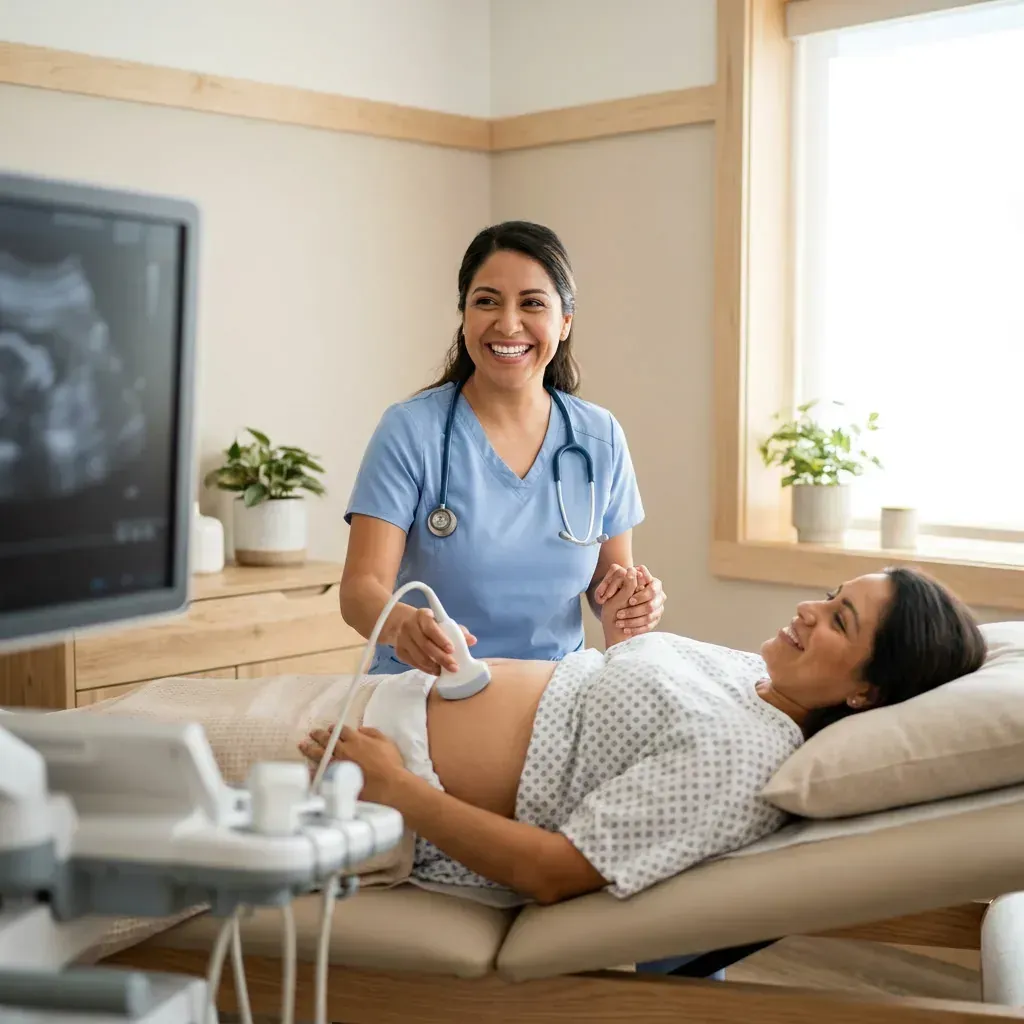
The visit starts with questions and a belly exam. If the medical team sees that an ultrasound will help, it's done right at the clinic. For the abdominal scan it's best to arrive having fasted for several hours, since food and gas block the picture; if you're not sure whether that applies to you, call (832) 271-0501 and we'll tell you. You lie down, gel goes on your skin and a transducer glides over it. It takes 15 to 30 minutes and mostly feels like pressure, though it may be a little uncomfortable over an area that's already sore.
While the transducer moves, the team tells you in Spanish what each shadow and outline on the monitor means, and the written report goes home with you. Sound doesn't travel well through air or bone, so ultrasound doesn't always give the full answer: if your case calls for a different study, such as a CT scan, a referral is arranged.
Notes worth jotting down while you decide
- What time the pain started and exactly where in your belly
- Whether it has moved since then
- Your temperature, if you have a thermometer
- How many times you've vomited or had diarrhea
- For women, the first day of the most recent period
- What you took for the pain and when, because a strong painkiller can mask symptoms
That list is just as useful at the clinic as in the ER, and it saves time in either place.
The short version
Belly pain without warning signs can be looked into at a regular visit, and abdominal ultrasound is one of the tools for doing that. Pain that won't let up, with high fever, nonstop vomiting, bleeding or fainting, goes straight to the ER or 911, skipping the clinic. If you're near Little York and your situation fits the first group, come by 10769 Eastex Fwy Ste A without an appointment; bring the list above and, if you can, come on an empty stomach.
Need medical attention?
We're here to help. Call now to schedule your appointment or visit our clinic without an appointment.
Call now: (832) 271-0501Related services
Ultrasound in Little York: Abdominal & Pregnancy
Abdominal, pelvic and pregnancy ultrasound in Little York, north Houston. No radiation, explained in Spanish, walk-in, no insurance needed.
UTI Care & Urine Testing in Little York
Urine testing and UTI treatment in Little York, north Houston. Burning, urgency or pain when urinating: walk-in and in Spanish.
Walk-In Pregnancy Test in Little York
Pregnancy testing in Little York, north Houston: confirmation, guidance and next steps in Spanish. Walk-in, confidential, no insurance needed.
Walk-In Blood Tests in Little York
Blood tests in Little York, north Houston: CBC, glucose, cholesterol, thyroid and more. Walk-in, in Spanish, no insurance needed.
Stool & Parasite Testing in Little York
Stool testing in Little York, north Houston: parasites, hidden blood and infections. Results explained in Spanish, walk-in, no insurance needed.