
It's 6:30 in the morning and seven-year-old Sofía walks out of her bedroom with one eye glued shut. Her mom softens the crust with a warm cotton ball, sees that the white of the eye has turned pink, and lands on the question so many north Houston families face every fall: school today, or not? Down the hall, her twelve-year-old brother has spent a week rubbing both eyes every time he comes in from the park, yet nobody has seen any gunk on him.
Both kids have a "red eye," and odds are they don't have the same thing. This guide helps you read the clues, handle the first days at home and decide calmly when missing class is the right call.
Three common causes, three different clues
Conjunctivitis is inflammation of the thin layer that covers the white of the eye and lines the inside of the eyelids. In children it nearly always comes from one of three sources:
| Viral | Bacterial | Allergic | |
|---|---|---|---|
| How it starts | Along with a cold or a sore throat | One eye wakes up stuck, sometimes spreading to the other | Seasonal, or after time outdoors or around pets |
| Discharge | Watery, like tears | Thick, yellow or greenish, returns after wiping | Clear and stringy |
| What the child feels | Burning or a gritty, sandy feeling | Lids crusted together on waking | Intense itch, nonstop rubbing |
| Contagious? | Yes, very | Yes | No |
| Extra hint | Runny nose, cough, a swollen gland by the ear | Mildly puffy eyelid | Sneezing and a stuffy nose at the same time |
No single clue settles it, and the causes can overlap: a child with allergies who rubs with dirty hands can pick up an infection on top. Even so, the table gives you a way to sort what you're seeing before you decide.
For Sofía, a crusted eye with yellow discharge points toward bacterial pink eye. Her brother's picture, with itching in both eyes, sneezing and no pus, looks much more like fall allergies: around Houston, ragweed and humidity-driven mold are still going strong in November.
What actually helps at home
While you decide whether a visit is needed, a few simple steps ease the discomfort and slow the spread:
- Clean each eye with its own gauze pad or cotton ball dipped in warm water, wiping from the inner corner outward, then throw it away.
- Wash your child's hands, and your own, before and after touching their face.
- Give them their own towel and pillowcase, and launder those separately in hot water.
- Ask them not to rub; trim their nails and, with little ones, redirect the hand that keeps drifting to the eye.
- If they wear contact lenses, they should skip them until the eye clears and toss the pair they were using.
- For allergy itch, a cool compress over closed eyelids brings real relief.
Don't use leftover eye drops from another family member, and skip home remedies such as breast milk, chamomile or urine in the eye. They can irritate the eye further or introduce new bacteria. Any eye medicine for a child should be chosen after an exam.
School or home?
This is where textbooks and district rules can differ. In Texas, schools follow state rules on contagious illness, and when an eye is crusted shut many will ask that the student stay home until someone checks it or until they bring a written note to return. Each campus applies it its own way, and the school nurse is usually the one who decides whether a child stays in class.
For a family whose shifts start early, here's what that means day to day:
- Eye stuck shut with thick discharge, or a red eye that began with a cold: the safest move is to keep them home until someone has examined it. If the school wants a note before they return, say so when you arrive for the visit.
- Itchy eyes, clear tearing and sneezing, with no pus: allergies aren't contagious, so there's no reason to miss school over them. If the classroom sends them home anyway, an exam helps make clear it's allergic.
- Fever: whatever is going on with the eye, the child goes back after a full day without fever and without fever-reducing medicine.
- A child who feels miserable, is listless or can't stop rubbing: better to rest at home, since they won't learn much and will keep spreading the virus.
MedlinePlus notes that the viral kind spreads as easily as a cold and usually lasts one to two weeks, even if the child feels fine sooner. In a house full of siblings, that means no shared blankets until it's over.
When to come in
Not every pink eye needs a visit, but it's worth one when:
- The discharge is thick and keeps coming back after you clean it.
- The eye isn't better in two or three days, or it's getting worse.
- Itching flares every season and is costing your child sleep or focus in class.
- Your child has asthma, eczema or another condition that allergies tend to stir up.
- The school is asking for a note before readmitting them.
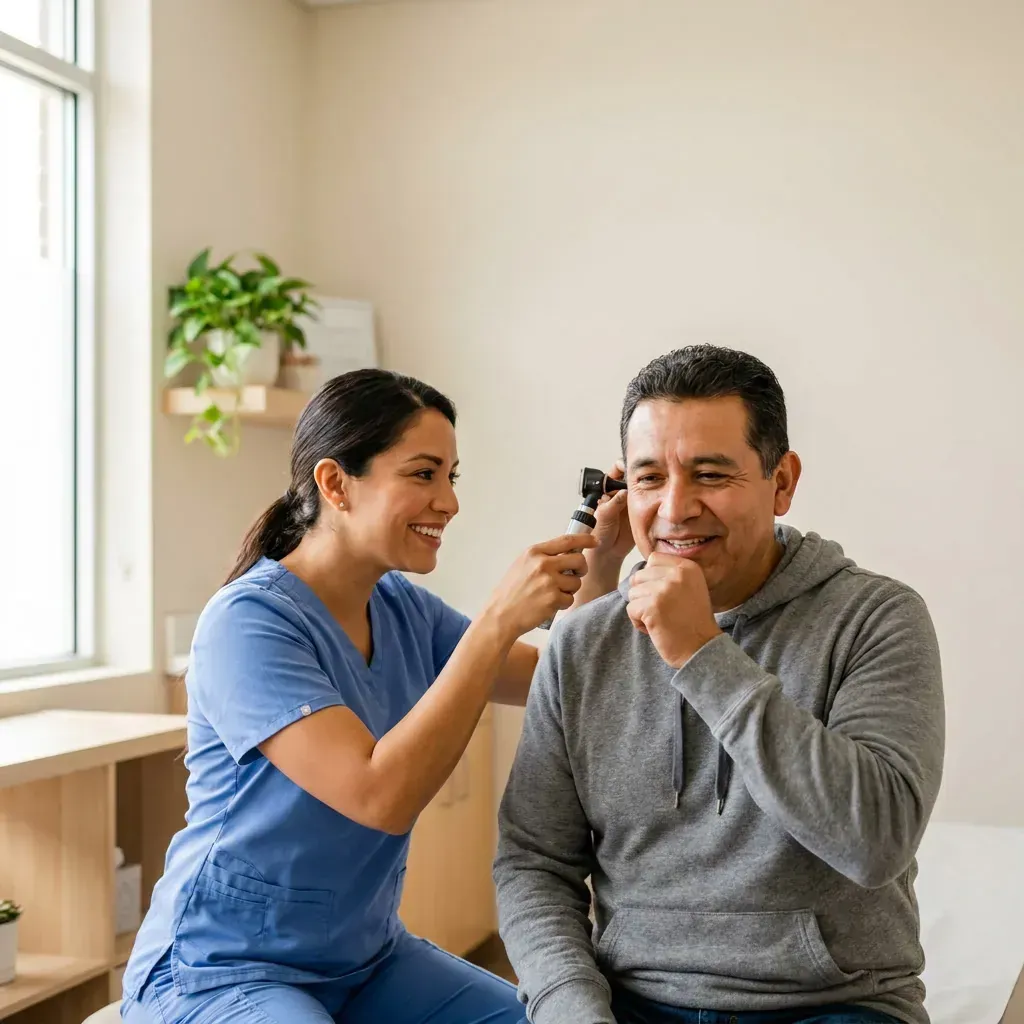
At Clínica Hispana Nueva Salud Little York, the clinic's medical team checks the eyes, the eyelids and the throat, asks about colds at home and the time of year, and explains in Spanish or English which type of conjunctivitis it looks like. When fever and cough come along, the visit overlaps with care for respiratory illnesses. When the pattern is allergic, it's handled through allergy care, where the triggers inside the house and out in the yard are tracked down.
If treatment is needed, you won't have to hunt for anything with a crying child on your hip: the e-prescription is sent to the pharmacy you choose, whether that's one along the Eastex Freeway or one near the school.
The red eye that can't wait until tomorrow
Some red eyes can't wait and shouldn't be handled at home. Get emergency care if your child has:
- Strong pain in the eye, not just burning or itching.
- Blurry vision that doesn't clear with blinking, or a lot of pain from light.
- A blow to the eye, something stuck in it, or the feeling that an object is still inside.
- Contact with a chemical such as bleach, cleaners, lime or glue. Flush right away with plenty of clean water and call 911 or Poison Control (1-800-222-1222).
- An eyelid that is very swollen, red and warm, especially with fever.
- A newborn baby with red eyes or any discharge, even if the baby seems calm.
None of these are ordinary pink eye: head to the ER or call 911.
The detail many parents miss
Sometimes the child rubbing their eyes all day has neither allergies nor an infection: they simply can't see the board well and their eyes get tired. If you notice squinting, holding the tablet very close or headaches after school, bring it up. The school physical many schools require includes a vision check, and it's a good moment to catch it.
Quick recap
Eye stuck shut with yellow crust: likely bacterial, contagious, best examined before going back to class. Red eye with a cold and clear tears: likely viral, contagious, so clean hands and patience. Itching in both eyes with sneezing: likely allergies, not contagious, eased by controlling what sets it off. And any strong pain, change in vision, injury, chemical or newborn goes straight to emergency care.
If someone in your 77093 household woke up with a red eye and you can't tell which group it falls into, come in with your child and, if you have it, the school form asking for clearance: the exam is done in Spanish, and you leave knowing what to do for the rest of the week.
Need medical attention?
We're here to help. Call now to schedule your appointment or visit our clinic without an appointment.
Call now: (832) 271-0501Related services
Allergy Care in Little York
Allergy care in Little York, north Houston: sneezing, congestion, watery eyes and hives. In Spanish, walk-in, no insurance needed.
Walk-In Flu & COVID Testing in Little York
Rapid flu and COVID testing in Little York, north Houston, plus care for cough, bronchitis and sore throat. Walk-in, in Spanish, no insurance.
School & Sports Physicals in Little York
School and sports physicals in Little York, north Houston: a full check-up and forms filled out. Walk-in, in Spanish, no insurance needed.
E-Prescriptions in Little York
E-prescriptions in Little York: after your visit we send your prescription to the pharmacy you choose, near home or work, so you pick it up when it suits you.